
Trees Inspected for Safety
In recent weeks, trees along roads, hiking trails, and other areas frequented by people in the Sonse Bergen, ’t Harde Ven, and ’t Zand have been assessed for safety risks. This is how we keep the forest safe for recreational users
Result
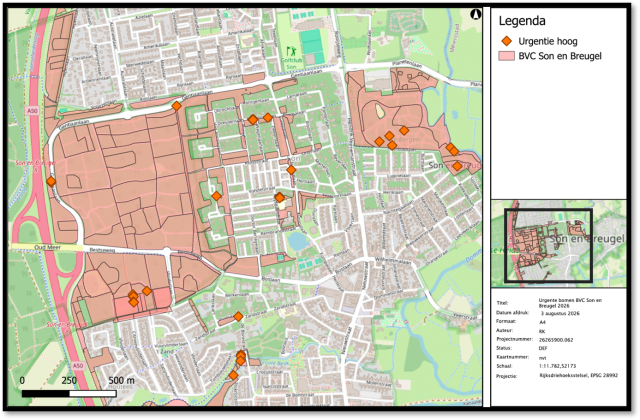
Based on the inspection, the recommendation is to cut down 667 trees and prune 717 trees. Immediate action is required for 30 trees due to safety risks. We will carry out these urgent measures as a priority. Where possible, we will combine the remaining measures with the planned thinning, or carry them out separately.
Marking
| Meaning | |
| dot layer | The tree needs to be pruned. This does not mean that the tree will be cut down. |
| dot high | Routine thinning. The tree is removed to make room for other trees. |
| cross | The tree is dead or severely weakened and must be cut down for safety reasons. |
| exclamation mark | Always in combination with a cross or a dot. The tree must be pruned or removed as soon as possible. |
Overview of Trees Requiring Immediate Attention
On the map below, you can see exactly where the tree safety inspection (BVC) was conducted and where the trees requiring urgent attention are located.
Tree Safety Inspection and Thinning
The tree safety inspection is conducted each year as part of the same work schedule as the regular forest thinning. This approach ensures that trees along roads, trails, and recreational facilities are inspected periodically. This year, a portion of the neighborhood forests has also been included in the work schedule for regular thinning. Therefore, the tree safety inspection will also be conducted in these forest sections.
We are also seeing tree die-off outside the monitored areas
The BVC is not a comprehensive inventory of all trees in these forested areas; the survey is limited to an area immediately adjacent to roads and trails. Dead and weakened trees outside the surveyed areas are therefore not included in these figures.
Increase in absenteeism
In recent years, we have seen an increase in tree mortality. For example, in December 2025, 195 Douglas firs along Gentiaanlaan and near the Oud Meer died.
Tree mortality was also clearly visible during the public walk on hydrological restoration in the West Forest Area on August 23, 2026, particularly among beech, birch, and larch trees.
We continue to work toward a more resilient forest
This trend is part of a nationwide pattern in which forest managers and researchers are reporting increasing tree mortality. Since 2018, dry years and periods of extreme precipitation have been following one another in rapid succession, leaving trees insufficient time to recover.
This loss underscores the direction of our forest management: gradually transforming former production forests into more diverse and resilient forests, with greater variety in tree species, ages, and forest structure.
The measures outlined in this BVC primarily concern scattered trees. The space created as a result allows surrounding trees and natural regeneration to continue developing. When larger groups of trees are lost at a given location, we assess whether additional forest regeneration is necessary. That is not the case with this BVC.
We continue to monitor the safety and growth of our forests through periodic tree safety inspections and regular forest management.